• Home
  • Year 9
    • Unit 1 - Bronze Age Greece >
      • Lesson 1 - Minoa
      • Lesson 2 - Myths
      • Lesson 3 - Atlantis
      • Lesson 4 - The Mycenaeans
      • Lesson 5 - Troy
      • End of Unit Test
    • Unit 2 - Classical Greece >
      • Lesson 1 - Archaic Period
      • Lesson 2 - Olympics
      • Lesson 3 - Athens
      • Lesson 4 - Democracy
      • Lesson 5 - Sparta
      • Lesson 6 - Greek Gods
      • Lesson 7 - Greek Legacy
      • End of Unit Test - 2
    • Unit 3 - Roman Republic >
      • Lesson 1 - Foundation
      • Lesson 2 - Republic
      • Lesson 3 - Hannibal
      • Lesson 4 - Julius Caesar
      • Lesson 5 - Rome
    • Unit 4 - Roman Empire >
      • Lesson 1 - Empire
      • Lesson 2 - Roman Nyon
      • Lesson 3 - Pompeii
      • Lesson 4 - Rise and Fall
      • Lesson 5 - Legacy
    • Unit 5 - The early Middle Ages >
      • Lesson 1 - Middle Ages?
      • Lesson 2 - Christianity
      • Lesson 3 - Monasteries
      • Lesson 4 - Justinian
      • Lesson 5 - Islam
      • Lesson 6 - Vikings
  • Year 11
    • Warfare - A study through time >
      • Lesson 1 - Introduction >
        • Warfare - Timeline activity >
          • Students' Timelines 2020
      • Lesson 2 - Medieval >
        • Case Study - 1066 - Battle of Hastings
      • Lesson 3 - Crusades >
        • Case Study - 1271 - Krak des Chevaliers
      • Lesson 4 - New World >
        • Case Study - 1532 - Battle of Cajamarca
      • Lesson 5 - Religion >
        • Case Study - 1572 - St. Bartholomew's Day Massacre
      • Lesson 6 - Napoleon >
        • Case Study - 1796 - Battle of Lodi
      • Lesson 7 - Industrial >
        • Case Study - 1859 - Battle of Solferino
      • Lesson 8 - World War 1 >
        • Case Study - 1915 - The Battle of Ypres
      • Lesson 9 - 1930s >
        • Case Study - 1937 - Nanjing Massacre
      • Lesson 10 - Vietnam >
        • Case Study - 1968 - Tet Offensive
    • Matu 1 - The American Revolution >
      • Lesson 1 - The Scientific Revolution
      • Lesson 2 - The Enlightenment
      • Lesson 3 - Enlightened Monarchs
      • Lesson 4 - Colonising America
      • Lesson 5 - Thirteen Colonies
      • Lesson 6 - Boston Massacre? >
        • Boston Massacre - The Play
      • Lesson 7 - Short-term causes
      • Lesson 8 - Why Britain lost
      • Lesson 9 - Consequences
      • Lesson 10 - How revolutionary?
    • Matu 2 - The French Revolution >
      • Lesson 1 - Introduction
      • Lesson 2 - Causes SE
      • Lesson 3 - Causes CP
      • Lesson 4 - Short term causes
      • Lesson 5 - The Bastille
      • Lesson 6 - 1789-91
      • Lesson 7 - 1793 Execution
      • Lesson 8 - The Terror
    • Matu 3 - Switzerland and Napoleon >
      • Lesson 1 - Ancien Regime
      • Lesson 2 - 1789
      • Lesson 3 - Napoleon's Rise
      • Lesson 4 - Napoleon in Art
      • Lesson 5 - Napoleon's Reforms
      • Lesson 6 - Switzerland 1798-1815
      • Lesson 7 - Napoleon's Europe
      • Lesson 8 - Napoleon: Hero or villain
  • S1 S2
    • Matu 4 - Industrial Revolution >
      • Lesson 1 - Why was Britain First?
      • Lesson 2 - Economics - Agriculture
      • Lesson 3 - Economics - Industry
      • Lesson 4 - Transport
      • Lesson 5 - Social Impact
      • Lesson 6 - Cultural Impact
      • Lesson 7 - Political Impact
      • Lesson 8 - Switzerland
    • Matu 5 - Nationalism >
      • Lesson 1 - Impact of French Revolution
      • Lesson 2 - Napoleon and Vienna
      • Lesson 3 - 1815-48 - Age of Revolution
      • Lesson 4 - Italian Unification - 1830-48
      • Lesson 5 - Switzerland 1815-48
      • Lesson 6 - Italian Unification - 1848-70
      • Lesson 7 - German Unification - 1848-71
      • Lesson 8 - The German Empire
    • Matu 6 - New Imperialism >
      • Lesson 1 - New Imperialism?
      • Lesson 2 - Africa
      • Lesson 3 - Congo
      • Lesson 4 - China
      • Lesson 5 - Japan
      • Lesson 6 - Legacy
      • Jared Diamond thesis
    • Matu 7 - World War 1 >
      • Lesson 1 - Introduction
      • Lesson 2 - Causes
      • Lesson 3 - 1914
      • Lesson 4 - Expectations
      • Lesson 5 - Reality
      • Lesson 6 - Total War
      • Lesson 7 - Switzerland
      • Lesson 8 - Defeat
      • Lesson 9 - Peace 1919
    • Matu 8 - Russian Revolutions >
      • Lesson 1 - Russia before 1917 >
        • Tim Marshall - Russia
      • Lesson 2 - 1905 Revolution
      • Lesson 3 - February Revolution
      • Lesson 4 - Marxism
      • Lesson 5 - Lenin
      • Lesson 6 - The Bolsheviks
      • Lesson 7 - 1917-18
      • Lesson 8 - Civil War
    • Matu 9 - USA 1919-41 >
      • Lesson 1 - 1920s boom
      • Lesson 2 - Roaring 20s?
      • Lesson 3 - Crash
      • Lesson 4 - 1932 Election
      • Lesson 5 - New Deal
      • Lesson 6 - Judging the New Deal
    • Matu 10 - Totalitarian States >
      • Lesson 1 - Modern Authoritarianism >
        • Is Trump's USA fascist?
      • Lesson 2 - Fascism
      • Lesson 3 - Mussolini - Rise to Power
      • Lesson 4 - Mussolini - Consolidation of Power
      • Lesson 5 - Mussolini - Aims and policies
      • Lesson 6 - Research presentations >
        • Hitler - Research presentations
        • Stalin- Research presentations
      • Lesson 7 - Hitler - Germany 1933-45 >
        • Hitler - Rise to Power
        • Hitler - Consolidation of Power
        • Hitler - Aims and policies
      • Lesson 8 - Stalin - USSR 1924-41 >
        • Stalin - Rise to Power
        • Stalin - Consolidation of Power
        • Stalin - Aims and policies
    • Exams and Revision
  • S3
    • Matu 11 - World War II >
      • Lesson 1 - WW1
      • Lesson 2 - LoN
      • Lesson 3 - Hitler
      • Lesson 4 - Appeasement
      • Lesson 5 - 1939-40
      • Lesson 6 - Japan
      • Lesson 7 - Russia
      • Lesson 8 - Total War
      • Lesson 9 - Defeat
      • Lesson 10 - Switzerland
    • Matu 12 - The Cold War >
      • Lesson 1 - Causes
      • Lesson 2 - Berlin
      • Lesson 3 - 1950s
      • Lesson 4 - 1960s
      • Lesson 5 - 1970s
      • Lesson 6 - 1980s
    • Matu 13 - Decolonisation and the Third World >
      • Lesson 1 - Factors
      • Lesson 2 - Case studies
      • Lesson 3 - Consequences
    • Matu 14 - Switzerland >
      • Swiss Politics
      • Swiss History
    • Exams and Revision
  • IB History
    • IB History - Paper 1 >
      • IB History - Paper 1 - Content
      • IB History - Paper 1 - Past paper questions >
        • Question 1a
        • Question 1b
        • Question 2
        • Question 3
        • Question 4
      • IB History - Paper 1 - Skills
    • IB History - Paper 2 >
      • IB History - Paper 2 past paper questions
      • IB History - 7. Industrialization >
        • IB History - Past paper questions - Industrialization
        • IB History - First and Second Industrial Revolution
        • IB History - Steven Johnson
        • Activity 1
      • IB History - 8. Independence movements >
        • IB History - Past paper questions - Independence movements
        • IB History - Revision Template - Independence movements >
          • IB History - Independence movements - Theme 1 - Origin and rise
          • IB History - Independence movements - Theme 2 - Methods
      • IB History - 10. Authoritarian States >
        • IB History - Emergence of authoritarian states
        • IB History - Consolidation and maintenance
        • IB History - Aims and policies
        • IB History - Past paper questions - Authoritarian states
        • IB History - Revision Template - Authoritarian states >
          • Hitler - Germany and Castro - Cuba - A comparative analysis (Part 1)
          • Hitler - Germany and Castro - Cuba - A comparative analysis (Part 2)
          • Hitler - Germany and Castro - Cuba - A comparative analysis (Part 3)
      • IB History - 11. Warfare >
        • IB History - Past paper questions - Warfare
      • IB History - 12. Cold War >
        • IB History - Past paper questions - Cold War
        • IB History - Revision essay plans - Cold War >
          • Cold War - 1943-49 - Rivalry, mistrust and accord
          • Cold War - 1947-79 - Rivalry, mistrust and accord
          • Cold War - 1980-91 - Rivalry, mistrust and accord
          • Cold War - Leaders, nations and Cold War crises.
    • IB History - IA - Internal Assessment
  • TOK
    • Critical Thinking >
      • Lesson 1 - Thinking >
        • Lesson 1 - Test
      • Lesson 2 - Language
      • Lesson 3 - Senses
      • Lesson 4 - Reason
      • Lesson 5 - Emotion
      • Assessment >
        • Movie perception test
        • Complete film
        • Student Films 2021
    • Core theme - Knowledge and the knower >
      • Knowledge framework
    • Areas of Knowledge >
      • History >
        • Scope in history
        • Method and perspective in history
        • Ethics in history
      • Human Science >
        • Scope in human science
        • Method and perspectives in human science
        • Ethics in human science
      • Natural Science >
        • Scope in natural science
        • Method and perspectives in natural science
        • Ethics in human science
      • Maths >
        • Scope in maths
        • Method and perspectives in maths
        • Ethics in maths
      • Arts >
        • Scope in the arts
        • Method and perspectives in arts
        • Ethics in the arts
      • Politics >
        • Scope in politics
        • Method and perspectives in politics
        • Ethics in politics
      • Technology >
        • Scope in technology
        • Method and perspectives in politics
        • Ethics in technology
      • Language >
        • Scope in language
        • Method and perspectives in language
        • Ethics in technology
    • Assessment >
      • TOK Exhibition >
        • TOK Exhibition 2023
        • TOK Exhibition 2024
        • TOK Exhibition 2025
      • Essay
    • Feature Films
  • Film Workshop
  • About
International School History
  • Home
  • Year 9
    • Unit 1 - Bronze Age Greece >
      • Lesson 1 - Minoa
      • Lesson 2 - Myths
      • Lesson 3 - Atlantis
      • Lesson 4 - The Mycenaeans
      • Lesson 5 - Troy
      • End of Unit Test
    • Unit 2 - Classical Greece >
      • Lesson 1 - Archaic Period
      • Lesson 2 - Olympics
      • Lesson 3 - Athens
      • Lesson 4 - Democracy
      • Lesson 5 - Sparta
      • Lesson 6 - Greek Gods
      • Lesson 7 - Greek Legacy
      • End of Unit Test - 2
    • Unit 3 - Roman Republic >
      • Lesson 1 - Foundation
      • Lesson 2 - Republic
      • Lesson 3 - Hannibal
      • Lesson 4 - Julius Caesar
      • Lesson 5 - Rome
    • Unit 4 - Roman Empire >
      • Lesson 1 - Empire
      • Lesson 2 - Roman Nyon
      • Lesson 3 - Pompeii
      • Lesson 4 - Rise and Fall
      • Lesson 5 - Legacy
    • Unit 5 - The early Middle Ages >
      • Lesson 1 - Middle Ages?
      • Lesson 2 - Christianity
      • Lesson 3 - Monasteries
      • Lesson 4 - Justinian
      • Lesson 5 - Islam
      • Lesson 6 - Vikings
  • Year 11
    • Warfare - A study through time >
      • Lesson 1 - Introduction >
        • Warfare - Timeline activity >
          • Students' Timelines 2020
      • Lesson 2 - Medieval >
        • Case Study - 1066 - Battle of Hastings
      • Lesson 3 - Crusades >
        • Case Study - 1271 - Krak des Chevaliers
      • Lesson 4 - New World >
        • Case Study - 1532 - Battle of Cajamarca
      • Lesson 5 - Religion >
        • Case Study - 1572 - St. Bartholomew's Day Massacre
      • Lesson 6 - Napoleon >
        • Case Study - 1796 - Battle of Lodi
      • Lesson 7 - Industrial >
        • Case Study - 1859 - Battle of Solferino
      • Lesson 8 - World War 1 >
        • Case Study - 1915 - The Battle of Ypres
      • Lesson 9 - 1930s >
        • Case Study - 1937 - Nanjing Massacre
      • Lesson 10 - Vietnam >
        • Case Study - 1968 - Tet Offensive
    • Matu 1 - The American Revolution >
      • Lesson 1 - The Scientific Revolution
      • Lesson 2 - The Enlightenment
      • Lesson 3 - Enlightened Monarchs
      • Lesson 4 - Colonising America
      • Lesson 5 - Thirteen Colonies
      • Lesson 6 - Boston Massacre? >
        • Boston Massacre - The Play
      • Lesson 7 - Short-term causes
      • Lesson 8 - Why Britain lost
      • Lesson 9 - Consequences
      • Lesson 10 - How revolutionary?
    • Matu 2 - The French Revolution >
      • Lesson 1 - Introduction
      • Lesson 2 - Causes SE
      • Lesson 3 - Causes CP
      • Lesson 4 - Short term causes
      • Lesson 5 - The Bastille
      • Lesson 6 - 1789-91
      • Lesson 7 - 1793 Execution
      • Lesson 8 - The Terror
    • Matu 3 - Switzerland and Napoleon >
      • Lesson 1 - Ancien Regime
      • Lesson 2 - 1789
      • Lesson 3 - Napoleon's Rise
      • Lesson 4 - Napoleon in Art
      • Lesson 5 - Napoleon's Reforms
      • Lesson 6 - Switzerland 1798-1815
      • Lesson 7 - Napoleon's Europe
      • Lesson 8 - Napoleon: Hero or villain
  • S1 S2
    • Matu 4 - Industrial Revolution >
      • Lesson 1 - Why was Britain First?
      • Lesson 2 - Economics - Agriculture
      • Lesson 3 - Economics - Industry
      • Lesson 4 - Transport
      • Lesson 5 - Social Impact
      • Lesson 6 - Cultural Impact
      • Lesson 7 - Political Impact
      • Lesson 8 - Switzerland
    • Matu 5 - Nationalism >
      • Lesson 1 - Impact of French Revolution
      • Lesson 2 - Napoleon and Vienna
      • Lesson 3 - 1815-48 - Age of Revolution
      • Lesson 4 - Italian Unification - 1830-48
      • Lesson 5 - Switzerland 1815-48
      • Lesson 6 - Italian Unification - 1848-70
      • Lesson 7 - German Unification - 1848-71
      • Lesson 8 - The German Empire
    • Matu 6 - New Imperialism >
      • Lesson 1 - New Imperialism?
      • Lesson 2 - Africa
      • Lesson 3 - Congo
      • Lesson 4 - China
      • Lesson 5 - Japan
      • Lesson 6 - Legacy
      • Jared Diamond thesis
    • Matu 7 - World War 1 >
      • Lesson 1 - Introduction
      • Lesson 2 - Causes
      • Lesson 3 - 1914
      • Lesson 4 - Expectations
      • Lesson 5 - Reality
      • Lesson 6 - Total War
      • Lesson 7 - Switzerland
      • Lesson 8 - Defeat
      • Lesson 9 - Peace 1919
    • Matu 8 - Russian Revolutions >
      • Lesson 1 - Russia before 1917 >
        • Tim Marshall - Russia
      • Lesson 2 - 1905 Revolution
      • Lesson 3 - February Revolution
      • Lesson 4 - Marxism
      • Lesson 5 - Lenin
      • Lesson 6 - The Bolsheviks
      • Lesson 7 - 1917-18
      • Lesson 8 - Civil War
    • Matu 9 - USA 1919-41 >
      • Lesson 1 - 1920s boom
      • Lesson 2 - Roaring 20s?
      • Lesson 3 - Crash
      • Lesson 4 - 1932 Election
      • Lesson 5 - New Deal
      • Lesson 6 - Judging the New Deal
    • Matu 10 - Totalitarian States >
      • Lesson 1 - Modern Authoritarianism >
        • Is Trump's USA fascist?
      • Lesson 2 - Fascism
      • Lesson 3 - Mussolini - Rise to Power
      • Lesson 4 - Mussolini - Consolidation of Power
      • Lesson 5 - Mussolini - Aims and policies
      • Lesson 6 - Research presentations >
        • Hitler - Research presentations
        • Stalin- Research presentations
      • Lesson 7 - Hitler - Germany 1933-45 >
        • Hitler - Rise to Power
        • Hitler - Consolidation of Power
        • Hitler - Aims and policies
      • Lesson 8 - Stalin - USSR 1924-41 >
        • Stalin - Rise to Power
        • Stalin - Consolidation of Power
        • Stalin - Aims and policies
    • Exams and Revision
  • S3
    • Matu 11 - World War II >
      • Lesson 1 - WW1
      • Lesson 2 - LoN
      • Lesson 3 - Hitler
      • Lesson 4 - Appeasement
      • Lesson 5 - 1939-40
      • Lesson 6 - Japan
      • Lesson 7 - Russia
      • Lesson 8 - Total War
      • Lesson 9 - Defeat
      • Lesson 10 - Switzerland
    • Matu 12 - The Cold War >
      • Lesson 1 - Causes
      • Lesson 2 - Berlin
      • Lesson 3 - 1950s
      • Lesson 4 - 1960s
      • Lesson 5 - 1970s
      • Lesson 6 - 1980s
    • Matu 13 - Decolonisation and the Third World >
      • Lesson 1 - Factors
      • Lesson 2 - Case studies
      • Lesson 3 - Consequences
    • Matu 14 - Switzerland >
      • Swiss Politics
      • Swiss History
    • Exams and Revision
  • IB History
    • IB History - Paper 1 >
      • IB History - Paper 1 - Content
      • IB History - Paper 1 - Past paper questions >
        • Question 1a
        • Question 1b
        • Question 2
        • Question 3
        • Question 4
      • IB History - Paper 1 - Skills
    • IB History - Paper 2 >
      • IB History - Paper 2 past paper questions
      • IB History - 7. Industrialization >
        • IB History - Past paper questions - Industrialization
        • IB History - First and Second Industrial Revolution
        • IB History - Steven Johnson
        • Activity 1
      • IB History - 8. Independence movements >
        • IB History - Past paper questions - Independence movements
        • IB History - Revision Template - Independence movements >
          • IB History - Independence movements - Theme 1 - Origin and rise
          • IB History - Independence movements - Theme 2 - Methods
      • IB History - 10. Authoritarian States >
        • IB History - Emergence of authoritarian states
        • IB History - Consolidation and maintenance
        • IB History - Aims and policies
        • IB History - Past paper questions - Authoritarian states
        • IB History - Revision Template - Authoritarian states >
          • Hitler - Germany and Castro - Cuba - A comparative analysis (Part 1)
          • Hitler - Germany and Castro - Cuba - A comparative analysis (Part 2)
          • Hitler - Germany and Castro - Cuba - A comparative analysis (Part 3)
      • IB History - 11. Warfare >
        • IB History - Past paper questions - Warfare
      • IB History - 12. Cold War >
        • IB History - Past paper questions - Cold War
        • IB History - Revision essay plans - Cold War >
          • Cold War - 1943-49 - Rivalry, mistrust and accord
          • Cold War - 1947-79 - Rivalry, mistrust and accord
          • Cold War - 1980-91 - Rivalry, mistrust and accord
          • Cold War - Leaders, nations and Cold War crises.
    • IB History - IA - Internal Assessment
  • TOK
    • Critical Thinking >
      • Lesson 1 - Thinking >
        • Lesson 1 - Test
      • Lesson 2 - Language
      • Lesson 3 - Senses
      • Lesson 4 - Reason
      • Lesson 5 - Emotion
      • Assessment >
        • Movie perception test
        • Complete film
        • Student Films 2021
    • Core theme - Knowledge and the knower >
      • Knowledge framework
    • Areas of Knowledge >
      • History >
        • Scope in history
        • Method and perspective in history
        • Ethics in history
      • Human Science >
        • Scope in human science
        • Method and perspectives in human science
        • Ethics in human science
      • Natural Science >
        • Scope in natural science
        • Method and perspectives in natural science
        • Ethics in human science
      • Maths >
        • Scope in maths
        • Method and perspectives in maths
        • Ethics in maths
      • Arts >
        • Scope in the arts
        • Method and perspectives in arts
        • Ethics in the arts
      • Politics >
        • Scope in politics
        • Method and perspectives in politics
        • Ethics in politics
      • Technology >
        • Scope in technology
        • Method and perspectives in politics
        • Ethics in technology
      • Language >
        • Scope in language
        • Method and perspectives in language
        • Ethics in technology
    • Assessment >
      • TOK Exhibition >
        • TOK Exhibition 2023
        • TOK Exhibition 2024
        • TOK Exhibition 2025
      • Essay
    • Feature Films
  • Film Workshop
  • About

S2 - Matu 7 - World War 1 - Lesson 3

Lesson 3 - 1914
There are few more dramatic moments in history than the assassination of Franz Ferdinand, June 28th 1914.  History teachers around the world love to tell the story of how 'bad driving caused the First World War' (I am no exception), documentary film makers enjoy the opportunity to focus on the tragedy and farce of the day's events, and anyone with any philosophical inclinations can't help but reflect on the counterfactual possibilities that (bad) luck unleashed on that day. But to be honest, June 28th 1914 isn't that important. It's what happens in the 37 days after that you need to learn and focus on. But most of you won't. 

So anyway on with the show. The password is 1914. 

How did bad driving cause the First World War?
Sunday 28 June 1914 was a bright and sunny day in Sarajevo. Sarajevo in Bosnia was preparing for a royal visitfrom Archduke Franz Ferdinand of Austria, Crowds lined the streets and waited for the procession of cars to appear. Hidden among the crowds, however, were six teenage [Bosnian Serb] terrorists sworn to kill the Archduke. They hated him and they hated Austria. They were stationed at intervals along the riverside route which the cars would follow on their way to the Town Hall. They all had bombs andpistols in their pockets, and phials of poison which they had promised to swallow if they were caught, so that they would not give the others away. It seemed as if the plan could not fail.

Finally, the cavalcade of four large cars came into sight. The Archduke was in a green open-topped car. He looked every inch a duke, wearing a pale blue uniform, a row of glittering medals and a military hat decorated with green ostrich feathers. Beside him sat his wife Sophie, looking beautiful in a white dress and a broad hat and waving politely to the crowd.

At 10.15 the cars passed Mehmedbasic, the first in line of the waiting killers. He took fright, did nothing, and then escaped. The next assassin, Cabriolvic, also lost his nerve and did nothing. But then as the cars passed the Cumurja Bridge, Cabrinovic threw his bomb, swallowed his poison, and jumped into the river. The Archduke saw the bomb coming and threw it off his car, but it exploded under the car behind, injuring several people. Now there was total confusion as the procession accelerated away, fearing more bombs. Meanwhile the police dragged Cabrinovic out of the river. His cyanide was old and had not worked.

The Archduke was driven to the Town Hall, where he demanded to be taken to visit the bomb victims in hospital. Fearing more terrorists, the officials decided to take a new route to avoid the crowds, but this was not properly explained to the driver of the Archduke’s car. Moreover, no police guard went with the procession.

Meanwhile the other assassins, on hearing the bomb explode, assumed the Archduke was dead and left - all except Princip, who soon discovered the truth. Miserably he wandered across the street towards Schiller’s delicatessen and café.

Princip was standing outside the café when, at 10.45, the Archduke’s car suddenly appeared beside him and turned into Franz Josef Street. This was a mistake, for according to the new plan the procession should have continued straight along the Appel Quay. As the driver realised he had taken a wrong turn he stopped and started to reverse. Princip could hardly believe his luck. Pulling an automatic pistol from the right-handpocket of his coat, he fired two shots at a range of just 3 or 4 metres. He could not miss. One bullet pierced the Archduke’s neck and the other ricocheted off the car into Sophie’s stomach. Fifteen minutes later she died and the Archduke followed soon after.
Princip was immediately seized. He managed to swallow his poison, but it did not work and he was taken off to prison. All the plotters except Mehmedbasic were eventually caught, but only the organiser, Ilic, was hanged, for the others were too young for the death penalty. Princip died in an Austrian jail, however, in April 1918, aged twenty-three.

Adapted from Britain at War by Craig Mair, 1982. 
What happened next?

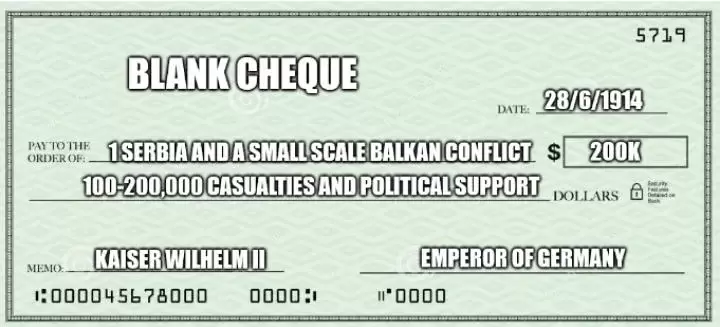
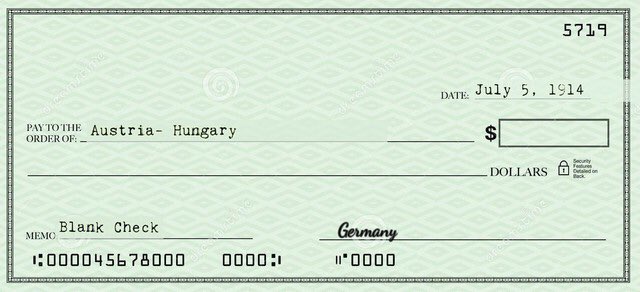
Although there was no firm evidence that Serbia’s government had ordered the assassination, Austria-Hungary held Serbia responsible. Vienna decided that years of restraint had failed and that Serbia now posed an existential threat to the empire. Before acting, however, Austria sought reassurance from Germany. In early July, Germany offered full diplomatic support, the so-called blank cheque, which convinced Austrian leaders that they could act without risking isolation.  Germany offered the blank cheque because they did not believe monarchist Russia would defend Serbia over an assassination of royalty, especially when its army reforms - 'Great Programme' of 1913 - would not be ready for a number of years. 
Picture
Picture
The blank cheque is a metaphor that students used to understand in the days before electronic banking. Having to explain this makes me feel very old.
Austria did not act immediately. The delay was partly practical, the empire was a slow decision making machine and the harvest season made immediate mobilisation difficult, but it was also strategic. Vienna wanted time to prepare a carefully framed ultimatum and to avoid acting while France’s leadership was visiting Russia (20–23 July), when alliance solidarity was being reinforced. 

On 23 July, Austria delivered a ten-point ultimatum to Serbia. Its demands went far beyond punishment and would have seriously limited Serbian sovereignty, effectively treating Serbia as a subordinate state. Although designed to be rejected, Serbia’s reply on 25 July was remarkably conciliatory, accepting most demands while rejecting those that undermined its legal independence. When Kaiser Wilhelm II read the reply, he reportedly remarked that it removed the main reason for war and suggested that Austria might settle for a temporary occupation of Belgrade.

However, Austrian leaders ignored both the Serbian reply and the Kaiser’s hesitation, broke off diplomatic relations, and on 28 July 1914 declared war. The slide into wider conflict had begun, not through haste, but through calculated delay, conditional support, and decisions taken in the belief that waiting would only make things worse. 
Activity 1
1. Why did Austria-Hungary decide to blame Serbia for the assassination even though there was no firm evidence that the Serbian government had ordered it?
2. What was the “Blank Cheque”, and how did German support influence Austria-Hungary’s decision-making in July 1914?
3. Give two reasons why Austria-Hungary delayed issuing the ultimatum to Serbia in July 1914.

Did a sandwich cause the First World War? (A short detour)

The film you just watched - Days that shook the world - is very popular with history teachers around the world. Having watched it you can probably understand why. It is not too long, it's quite dramatic, and it deliberately imitates the style of a famous director who became very popular about 30 years ago. But it also has one unfortunate consequence, students remember an event that didn't happen.  Mike Dash wrote about it in the Smithsonian magazine a few years ago and fellow history teacher Scott Allsop made a jolly little film about it. Although in my view the origin of the sandwich myth started with the Channel 4 documentary below.

The July Crisis 

23 July - Having secured the support of Germany (the Blank Cheque), Austria-Hungary blamed Serbia for the assassination of Franz Ferdinand and issued a ten-point ultimatum. The demands went far beyond punishment and would have seriously limited Serbian sovereignty. Although Austria presented it as a diplomatic measure, it was deliberately framed to be extremely difficult to accept. Despite this Serbia - still recovering from the the Balkan Wars - prepared to accept the terms but Russian encouragement (who had been promised French support) stregthened Serbian resolve. 

28 July - Austria declared war on Serbia and began shelling Belgrade. This marked the shift from diplomacy to force, but the conflict was still regional. Austrian leaders believed that further restraint would signal weakness and that a decisive move was necessary to preserve the empire’s authority.

29 July - The Russia began mobilisation to support Serbia. Russian leaders feared that abandoning Serbia would repeat the humiliation of 1909 and permanently weaken Russia’s status as a Great Power. Although some hoped mobilisation could be limited to Austria-Hungary, Russian war plans assumed preparation for a wider conflict, including against Germany. Germany warned Russia that any mobilisation would be treated as a hostile act.

Matu exam source alert
Picture
30 July 1914: The Willy–Nicky telegrams

On 30 July 1914, as the crisis escalated rapidly, the royal cousins Kaiser Wilhelm II and Tsar Nicholas II exchanged a series of personal telegrams. These messages, known as the Willy–Nicky correspondence, took place at a moment when diplomacy still existed, but was being overtaken by mobilisation and military planning.

Both rulers claimed they wanted to preserve peace. Nicholas argued that Russia’s actions were defensive and driven by pressure to protect Serbia, while Wilhelm warned that Russian mobilisation would force Germany to respond. The telegrams reveal genuine attempts at restraint, but also deep misunderstanding. Each side believed the other still had full control, when in reality decisions were already being shaped by generals, timetables, and alliance expectations. (see Security Dilemma below)

The importance of the telegrams lies in what they show about lost control. Personal appeals could not reverse mobilisation once it began, and by the time the messages were exchanged, events were already slipping beyond the reach of individual rulers.

Nicholas II: “I give you my solemn word that these measures do not mean war.”
Wilhelm II: “Military measures on your side would hasten a catastrophe.”

30 July - Germany decides on full mobilisation.  Kaiser Wilhelm II briefly believed war might be avoided when ambiguous signals from British Foreign Minister Edward Grey suggested Britain might remain neutral, a moment he reportedly celebrated with champagne. Wilhelm ordered mobilisation only on the Eastern front.  He was told this was impossible: German war planning required full mobilisation, and once set in motion the railway timetables could not be altered without disaster.

1 August
 - Germany declared war on Russia. German leaders believed that Russian mobilisation confirmed their long-standing fear that war was coming sooner rather than later. Under the Schlieffen Plan, Germany’s strategy assumed that a war in the east would inevitably involve France, so German forces began moving west towards France and through Belgium.

2 August - France placed its army on a war footing. French leaders feared isolation and believed that failing to prepare would leave France vulnerable to a German attack. Years of alliance planning with Russia meant that France could not remain passive once Germany acted.

3 August - Germany declared war on France and invaded Belgium. Britain demanded that Germany withdraw. By this point, the logic of military plans and alliance expectations had overtaken diplomacy, and each side claimed to be acting defensively.

4 August - With German troops still in Belgium, Great Britain declared war on Germany. The decision was shaped not only by Belgian neutrality but by a belief, argued forcefully by Edward Grey, that Britain had a moral obligation to France and could not afford to stand aside while a hostile power dominated the continent.

6 August - Austria-Hungary declared war on Russia. What had begun as a Balkan conflict was now a full European war, driven not by a single decision but by a sequence of choices in which delay, mobilisation, and alliance commitments steadily narrowed the options for peace.

Game theory, the arms race and 'sooner rather than later'

The most important questions about the summer of 1914 revolve around why Germany gave the blank cheque and why Russia mobilised.  Game Theory helps us understand how countries can end up in a war even when none of them really wants one. Game Theory is the study of how decisions are made when the outcome depends on what others do. It focuses on strategic situations, where each side must think about how another person or country might react. The central idea is that even when everyone prefers peace or cooperation, their fear of what others might do can push them into conflict or competition instead. Originally developed to understand strategy and decision-making, Game Theory is now used in economics, politics, international relations, and many other fields to explain why rational choices can still lead to bad outcomes.

Game Theory helps explain how countries can be pushed into actions they do not really want. When each country’s safety depends on what others might do, even defensive moves look threatening. This is called the security dilemma. Before 1914, the arms race made this worse: Germany feared Russia’s growing military power, while Russia feared losing influence in the Balkans if it did not protect Serbia. Both believed that waiting would only weaken their position.
Picture
Picture
The July Crisis turned this tension into a chain reaction. Germany’s Blank Cheque encouraged Austria-Hungary to confront Serbia. Russia then began mobilisation to defend Serbia, seeing this as a defensive step. But to Germany, Russian mobilisation looked like preparation for war. In Game Theory terms, each move narrowed the choices of the others and made quick escalation seem the safest option.

A final pressure came from the realities of war by railway timetable. Mobilising millions of soldiers required precise train schedules. Once a country started mobilisation, stopping or slowing down was almost impossible. This meant that hesitation was dangerous: if your enemy mobilised first, you risked falling behind. Germany and Russia therefore felt they had to move immediately, even though this increased the chance of war.
Activity 2
​
  1. What does Game Theory help us understand about why countries like Germany and Russia acted as they did in 1914?
  2. How did the arms race and the security dilemma make both Germany and Russia feel that 'waiting' was dangerous?
  3. Why did military planning and railway timetables make mobilisation a point of no return during the July Crisis?

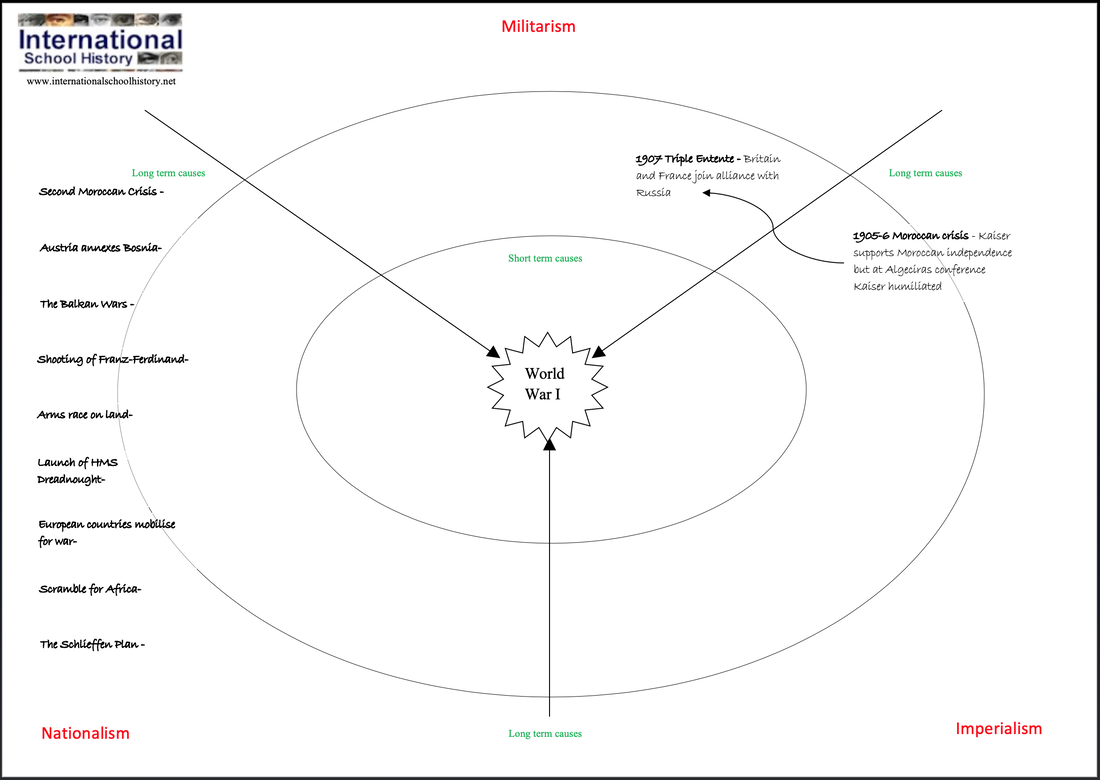
Assessed revision activity - Complete the revision diagram. ​
In class you will be given a blank copy of the diagram and 12 cards with various events that contributed to causing WW1.  You will need to know the dates of these events: Franco-Prussian War, Serbian independence, Scramble for Africa, The Triple Alliance, HMS Dreadnought, Austria annexes Bosnia, Italy invades Libya, Second Moroccan Crisis, The Balkan Wars, Russian Great Programme (army reforms), Franz Ferdinand shot, Mobilisation for war.

​First add the correct dates to the event cards then move them into the correct place on the diagram. You will arrange chronologically (long-term or short-term) and thematically (militarism, imperialism and nationalism). Finally, you need to draw lines making connections between events as illustrated on the diagram.  Take an image of your completed work and upload to your OneNote.
Picture

​Extension and extras

For the keen student with three hours to kill there are these three rather brilliant films that dramatise the 37 days after the assassination to the outbreak of the war. Produced exactly 100 years after the summer of 1914, the first episode covers the first month after the assassinatio cover the next week and final episode covers the last 'long weekend'.  

Opposite is a video from the 1970s. A.J.P Taylor was probably the most famous historian in the world at the time; so famous that the BBC made television programmes that were no more than a single camera recording him talking in a single take.

​He had no notes or teleprompter. He was not reading. This is an extract from a series he called 'How Wars Begin'. It is quite short, so try to watch it all in one go. 

Make a few notes as he talks, it is a lecture, it's what his students would be expected to do. At the end, see if you can explain in no more than 150 words what he thinks caused the First World War. 

​If you are feeling particularly ambitious and want to see what modern university lecturers sound like, watch sleepwalkers a talk by historian 
Christopher Clark which I have mentioned before. 

​As a revision and general overview watch John Green's take on events. (Below)

The little brother of internationalschoolhistory.net - Richard Jones-Nerzic- Nyon, Switzerland 2026 
The views expressed on this website are those of the author and not necessarily endorsed by the author's employer. 
  • Home
  • Year 9
    • Unit 1 - Bronze Age Greece >
      • Lesson 1 - Minoa
      • Lesson 2 - Myths
      • Lesson 3 - Atlantis
      • Lesson 4 - The Mycenaeans
      • Lesson 5 - Troy
      • End of Unit Test
    • Unit 2 - Classical Greece >
      • Lesson 1 - Archaic Period
      • Lesson 2 - Olympics
      • Lesson 3 - Athens
      • Lesson 4 - Democracy
      • Lesson 5 - Sparta
      • Lesson 6 - Greek Gods
      • Lesson 7 - Greek Legacy
      • End of Unit Test - 2
    • Unit 3 - Roman Republic >
      • Lesson 1 - Foundation
      • Lesson 2 - Republic
      • Lesson 3 - Hannibal
      • Lesson 4 - Julius Caesar
      • Lesson 5 - Rome
    • Unit 4 - Roman Empire >
      • Lesson 1 - Empire
      • Lesson 2 - Roman Nyon
      • Lesson 3 - Pompeii
      • Lesson 4 - Rise and Fall
      • Lesson 5 - Legacy
    • Unit 5 - The early Middle Ages >
      • Lesson 1 - Middle Ages?
      • Lesson 2 - Christianity
      • Lesson 3 - Monasteries
      • Lesson 4 - Justinian
      • Lesson 5 - Islam
      • Lesson 6 - Vikings
  • Year 11
    • Warfare - A study through time >
      • Lesson 1 - Introduction >
        • Warfare - Timeline activity >
          • Students' Timelines 2020
      • Lesson 2 - Medieval >
        • Case Study - 1066 - Battle of Hastings
      • Lesson 3 - Crusades >
        • Case Study - 1271 - Krak des Chevaliers
      • Lesson 4 - New World >
        • Case Study - 1532 - Battle of Cajamarca
      • Lesson 5 - Religion >
        • Case Study - 1572 - St. Bartholomew's Day Massacre
      • Lesson 6 - Napoleon >
        • Case Study - 1796 - Battle of Lodi
      • Lesson 7 - Industrial >
        • Case Study - 1859 - Battle of Solferino
      • Lesson 8 - World War 1 >
        • Case Study - 1915 - The Battle of Ypres
      • Lesson 9 - 1930s >
        • Case Study - 1937 - Nanjing Massacre
      • Lesson 10 - Vietnam >
        • Case Study - 1968 - Tet Offensive
    • Matu 1 - The American Revolution >
      • Lesson 1 - The Scientific Revolution
      • Lesson 2 - The Enlightenment
      • Lesson 3 - Enlightened Monarchs
      • Lesson 4 - Colonising America
      • Lesson 5 - Thirteen Colonies
      • Lesson 6 - Boston Massacre? >
        • Boston Massacre - The Play
      • Lesson 7 - Short-term causes
      • Lesson 8 - Why Britain lost
      • Lesson 9 - Consequences
      • Lesson 10 - How revolutionary?
    • Matu 2 - The French Revolution >
      • Lesson 1 - Introduction
      • Lesson 2 - Causes SE
      • Lesson 3 - Causes CP
      • Lesson 4 - Short term causes
      • Lesson 5 - The Bastille
      • Lesson 6 - 1789-91
      • Lesson 7 - 1793 Execution
      • Lesson 8 - The Terror
    • Matu 3 - Switzerland and Napoleon >
      • Lesson 1 - Ancien Regime
      • Lesson 2 - 1789
      • Lesson 3 - Napoleon's Rise
      • Lesson 4 - Napoleon in Art
      • Lesson 5 - Napoleon's Reforms
      • Lesson 6 - Switzerland 1798-1815
      • Lesson 7 - Napoleon's Europe
      • Lesson 8 - Napoleon: Hero or villain
  • S1 S2
    • Matu 4 - Industrial Revolution >
      • Lesson 1 - Why was Britain First?
      • Lesson 2 - Economics - Agriculture
      • Lesson 3 - Economics - Industry
      • Lesson 4 - Transport
      • Lesson 5 - Social Impact
      • Lesson 6 - Cultural Impact
      • Lesson 7 - Political Impact
      • Lesson 8 - Switzerland
    • Matu 5 - Nationalism >
      • Lesson 1 - Impact of French Revolution
      • Lesson 2 - Napoleon and Vienna
      • Lesson 3 - 1815-48 - Age of Revolution
      • Lesson 4 - Italian Unification - 1830-48
      • Lesson 5 - Switzerland 1815-48
      • Lesson 6 - Italian Unification - 1848-70
      • Lesson 7 - German Unification - 1848-71
      • Lesson 8 - The German Empire
    • Matu 6 - New Imperialism >
      • Lesson 1 - New Imperialism?
      • Lesson 2 - Africa
      • Lesson 3 - Congo
      • Lesson 4 - China
      • Lesson 5 - Japan
      • Lesson 6 - Legacy
      • Jared Diamond thesis
    • Matu 7 - World War 1 >
      • Lesson 1 - Introduction
      • Lesson 2 - Causes
      • Lesson 3 - 1914
      • Lesson 4 - Expectations
      • Lesson 5 - Reality
      • Lesson 6 - Total War
      • Lesson 7 - Switzerland
      • Lesson 8 - Defeat
      • Lesson 9 - Peace 1919
    • Matu 8 - Russian Revolutions >
      • Lesson 1 - Russia before 1917 >
        • Tim Marshall - Russia
      • Lesson 2 - 1905 Revolution
      • Lesson 3 - February Revolution
      • Lesson 4 - Marxism
      • Lesson 5 - Lenin
      • Lesson 6 - The Bolsheviks
      • Lesson 7 - 1917-18
      • Lesson 8 - Civil War
    • Matu 9 - USA 1919-41 >
      • Lesson 1 - 1920s boom
      • Lesson 2 - Roaring 20s?
      • Lesson 3 - Crash
      • Lesson 4 - 1932 Election
      • Lesson 5 - New Deal
      • Lesson 6 - Judging the New Deal
    • Matu 10 - Totalitarian States >
      • Lesson 1 - Modern Authoritarianism >
        • Is Trump's USA fascist?
      • Lesson 2 - Fascism
      • Lesson 3 - Mussolini - Rise to Power
      • Lesson 4 - Mussolini - Consolidation of Power
      • Lesson 5 - Mussolini - Aims and policies
      • Lesson 6 - Research presentations >
        • Hitler - Research presentations
        • Stalin- Research presentations
      • Lesson 7 - Hitler - Germany 1933-45 >
        • Hitler - Rise to Power
        • Hitler - Consolidation of Power
        • Hitler - Aims and policies
      • Lesson 8 - Stalin - USSR 1924-41 >
        • Stalin - Rise to Power
        • Stalin - Consolidation of Power
        • Stalin - Aims and policies
    • Exams and Revision
  • S3
    • Matu 11 - World War II >
      • Lesson 1 - WW1
      • Lesson 2 - LoN
      • Lesson 3 - Hitler
      • Lesson 4 - Appeasement
      • Lesson 5 - 1939-40
      • Lesson 6 - Japan
      • Lesson 7 - Russia
      • Lesson 8 - Total War
      • Lesson 9 - Defeat
      • Lesson 10 - Switzerland
    • Matu 12 - The Cold War >
      • Lesson 1 - Causes
      • Lesson 2 - Berlin
      • Lesson 3 - 1950s
      • Lesson 4 - 1960s
      • Lesson 5 - 1970s
      • Lesson 6 - 1980s
    • Matu 13 - Decolonisation and the Third World >
      • Lesson 1 - Factors
      • Lesson 2 - Case studies
      • Lesson 3 - Consequences
    • Matu 14 - Switzerland >
      • Swiss Politics
      • Swiss History
    • Exams and Revision
  • IB History
    • IB History - Paper 1 >
      • IB History - Paper 1 - Content
      • IB History - Paper 1 - Past paper questions >
        • Question 1a
        • Question 1b
        • Question 2
        • Question 3
        • Question 4
      • IB History - Paper 1 - Skills
    • IB History - Paper 2 >
      • IB History - Paper 2 past paper questions
      • IB History - 7. Industrialization >
        • IB History - Past paper questions - Industrialization
        • IB History - First and Second Industrial Revolution
        • IB History - Steven Johnson
        • Activity 1
      • IB History - 8. Independence movements >
        • IB History - Past paper questions - Independence movements
        • IB History - Revision Template - Independence movements >
          • IB History - Independence movements - Theme 1 - Origin and rise
          • IB History - Independence movements - Theme 2 - Methods
      • IB History - 10. Authoritarian States >
        • IB History - Emergence of authoritarian states
        • IB History - Consolidation and maintenance
        • IB History - Aims and policies
        • IB History - Past paper questions - Authoritarian states
        • IB History - Revision Template - Authoritarian states >
          • Hitler - Germany and Castro - Cuba - A comparative analysis (Part 1)
          • Hitler - Germany and Castro - Cuba - A comparative analysis (Part 2)
          • Hitler - Germany and Castro - Cuba - A comparative analysis (Part 3)
      • IB History - 11. Warfare >
        • IB History - Past paper questions - Warfare
      • IB History - 12. Cold War >
        • IB History - Past paper questions - Cold War
        • IB History - Revision essay plans - Cold War >
          • Cold War - 1943-49 - Rivalry, mistrust and accord
          • Cold War - 1947-79 - Rivalry, mistrust and accord
          • Cold War - 1980-91 - Rivalry, mistrust and accord
          • Cold War - Leaders, nations and Cold War crises.
    • IB History - IA - Internal Assessment
  • TOK
    • Critical Thinking >
      • Lesson 1 - Thinking >
        • Lesson 1 - Test
      • Lesson 2 - Language
      • Lesson 3 - Senses
      • Lesson 4 - Reason
      • Lesson 5 - Emotion
      • Assessment >
        • Movie perception test
        • Complete film
        • Student Films 2021
    • Core theme - Knowledge and the knower >
      • Knowledge framework
    • Areas of Knowledge >
      • History >
        • Scope in history
        • Method and perspective in history
        • Ethics in history
      • Human Science >
        • Scope in human science
        • Method and perspectives in human science
        • Ethics in human science
      • Natural Science >
        • Scope in natural science
        • Method and perspectives in natural science
        • Ethics in human science
      • Maths >
        • Scope in maths
        • Method and perspectives in maths
        • Ethics in maths
      • Arts >
        • Scope in the arts
        • Method and perspectives in arts
        • Ethics in the arts
      • Politics >
        • Scope in politics
        • Method and perspectives in politics
        • Ethics in politics
      • Technology >
        • Scope in technology
        • Method and perspectives in politics
        • Ethics in technology
      • Language >
        • Scope in language
        • Method and perspectives in language
        • Ethics in technology
    • Assessment >
      • TOK Exhibition >
        • TOK Exhibition 2023
        • TOK Exhibition 2024
        • TOK Exhibition 2025
      • Essay
    • Feature Films
  • Film Workshop
  • About