• Home
  • Year 9
    • Unit 1 - Bronze Age Greece >
      • Lesson 1 - Minoa
      • Lesson 2 - Myths
      • Lesson 3 - Atlantis
      • Lesson 4 - The Mycenaeans
      • Lesson 5 - Troy
    • End of Unit Test >
      • End of Unit Test - 1
    • Unit 2 - Classical Greece >
      • Lesson 1 - Archaic Period
      • Lesson 2 - Olympics
      • Lesson 3 - Athens
      • Lesson 4 - Democracy
      • Lesson 5 - Sparta
      • Lesson 6 - Greek Gods
      • Lesson 7 - Greek Legacy
      • End of Unit Test - 2
    • Unit 3 - Roman Republic >
      • Lesson 1 - Foundation
      • Lesson 2 - Republic
      • Lesson 3 - Hannibal
      • Lesson 4 - Julius Caesar
      • Lesson 5 - Rome
    • Unit 4 - Roman Empire >
      • Lesson 1 - Empire
      • Lesson 2 - Roman Nyon
      • Lesson 3 - Pompeii
      • Lesson 4 - Rise and Fall
      • Lesson 5 - Legacy
    • Unit 5 - The early Middle Ages >
      • Lesson 1 - Middle Ages?
      • Lesson 2 - Christianity
      • Lesson 3 - Monasteries
      • Lesson 4 - Justinian
      • Lesson 5 - Islam
      • Lesson 6 - Vikings
  • Year 11
    • Warfare - A study through time >
      • Lesson 1 - Introduction >
        • Warfare - Timeline activity >
          • Students' Timelines 2020
      • Lesson 2 - Medieval >
        • Case Study - 1066 - Battle of Hastings
      • Lesson 3 - Crusades >
        • Case Study - 1271 - Krak des Chevaliers
      • Lesson 4 - New World >
        • Case Study - 1532 - Battle of Cajamarca
      • Lesson 5 - Religion >
        • Case Study - 1572 - St. Bartholomew's Day Massacre
      • Lesson 6 - Napoleon >
        • Case Study - 1796 - Battle of Lodi
      • Lesson 7 - Industrial >
        • Case Study - 1859 - Battle of Solferino
      • Lesson 8 - World War 1 >
        • Case Study - 1915 - The Battle of Ypres
      • Lesson 9 - 1930s >
        • Case Study - 1937 - Nanjing Massacre
      • Lesson 10 - Vietnam >
        • Case Study - 1968 - Tet Offensive
    • Matu 1 - The American Revolution >
      • Lesson 1 - The Scientific Revolution
      • Lesson 2 - The Enlightenment
      • Lesson 3 - Enlightened Monarchs
      • Lesson 4 - Colonising America
      • Lesson 5 - Thirteen Colonies
      • Lesson 6 - Boston Massacre? >
        • Boston Massacre - The Play
      • Lesson 7 - Short-term causes
      • Lesson 8 - Why Britain lost
      • Lesson 9 - Consequences
      • Lesson 10 - How revolutionary?
    • Matu 2 - The French Revolution >
      • Lesson 1 - Introduction
      • Lesson 2 - Causes SE
      • Lesson 3 - Causes CP
      • Lesson 4 - Short term causes
      • Lesson 5 - The Bastille
      • Lesson 6 - 1789-91
      • Lesson 7 - 1793 Execution
      • Lesson 8 - The Terror
    • Matu 3 - Switzerland and Napoleon >
      • Lesson 1 - Ancien Regime
      • Lesson 2 - 1789
      • Lesson 3 - Napoleon's Rise
      • Lesson 4 - Napoleon in Art
      • Lesson 5 - Napoleon's Reforms
      • Lesson 6 - Switzerland 1798-1815
      • Lesson 7 - Napoleon's Europe
      • Lesson 8 - Napoleon: Hero or villain
  • S1 S2
    • Matu 4 - Industrial Revolution >
      • Lesson 1 - Why was Britain First?
      • Lesson 2 - Economics - Agriculture
      • Lesson 3 - Economics - Industry
      • Lesson 4 - Transport
      • Lesson 5 - Social Impact
      • Lesson 6 - Cultural Impact
      • Lesson 7 - Political Impact
      • Lesson 8 - Switzerland
    • Matu 5 - Nationalism >
      • Lesson 1 - Impact of French Revolution
      • Lesson 2 - Napoleon and Vienna
      • Lesson 3 - 1815-48 - Age of Revolution
      • Lesson 4 - Italian Unification - 1830-48
      • Lesson 5 - Switzerland 1815-48
      • Lesson 6 - Italian Unification - 1848-70
      • Lesson 7 - German Unification - 1848-71
      • Lesson 8 - The German Empire
    • Matu 6 - New Imperialism >
      • Lesson 1 - New Imperialism?
      • Lesson 2 - Africa
      • Lesson 3 - Congo
      • Lesson 4 - China
      • Lesson 5 - Japan
      • Lesson 6 - Legacy
      • Jared Diamond thesis
    • Matu 7 - World War 1 >
      • Lesson 1 - Introduction
      • Lesson 2 - Causes
      • Lesson 3 - 1914
      • Lesson 4 - Expectations
      • Lesson 5 - Reality
      • Lesson 6 - Total War
      • Lesson 7 - Switzerland
      • Lesson 8 - Defeat
      • Lesson 9 - Peace 1919
    • Matu 8 - Russian Revolutions >
      • Lesson 1 - Russia before 1917 >
        • Tim Marshall - Russia
      • Lesson 2 - 1905 Revolution
      • Lesson 3 - February Revolution
      • Lesson 4 - Marxism
      • Lesson 5 - Lenin
      • Lesson 6 - The Bolsheviks
      • Lesson 7 - 1917-18
      • Lesson 8 - Civil War
    • Matu 9 - USA 1919-41 >
      • Lesson 1 - 1920s boom
      • Lesson 2 - Roaring 20s?
      • Lesson 3 - Crash
      • Lesson 4 - 1932 Election
      • Lesson 5 - New Deal
      • Lesson 6 - Judging the New Deal
    • Matu 10 - Totalitarian States >
      • Lesson 1 - Modern Authoritarianism >
        • Is Trump's USA authoritarian?
      • Lesson 2 - Fascism
      • Lesson 3 - Mussolini - Rise to Power
      • Lesson 4 - Mussolini - Consolidation of Power
      • Lesson 5 - Mussolini - Aims and policies
      • Lesson 6 - Research presentations >
        • Hitler - Research presentations
        • Stalin- Research presentations
      • Lesson 7 - Hitler - Germany 1933-45 >
        • Hitler - Rise to Power
        • Hitler - Consolidation of Power
        • Hitler - Aims and policies
      • Lesson 8 - Stalin - USSR 1924-41 >
        • Stalin - Rise to Power
        • Stalin - Consolidation of Power
        • Stalin - Aims and policies
    • Exams and Revision
  • S3
    • Matu 11 - World War II >
      • Lesson 1 - WW1
      • Lesson 2 - LoN
      • Lesson 3 - Hitler
      • Lesson 4 - Appeasement
      • Lesson 5 - 1939-40
      • Lesson 6 - Japan
      • Lesson 7 - Russia
      • Lesson 8 - Total War
      • Lesson 9 - Defeat
      • Lesson 10 - Switzerland
    • Matu 12 - The Cold War >
      • Lesson 1 - Causes
      • Lesson 2 - Berlin
      • Lesson 3 - 1950s
      • Lesson 4 - 1960s
      • Lesson 5 - 1970s
      • Lesson 6 - 1980s
    • Matu 13 - Decolonisation and the Third World >
      • Lesson 1 - Factors
      • Lesson 2 - Case studies
      • Lesson 3 - Consequences
    • Matu 14 - Switzerland >
      • Swiss Politics
      • Swiss History
    • Exams and Revision
  • IB History
    • IB History - Paper 1 >
      • IB History - Paper 1 - Content
      • IB History - Paper 1 - Past paper questions >
        • Question 1a
        • Question 1b
        • Question 2
        • Question 3
        • Question 4
      • IB History - Paper 1 - Skills
    • IB History - Paper 2 >
      • IB History - Paper 2 past paper questions
      • IB History - 7. Industrialization >
        • IB History - Past paper questions - Industrialization
        • IB History - First and Second Industrial Revolution
        • IB History - Steven Johnson
        • Activity 1
      • IB History - 8. Independence movements >
        • IB History - Past paper questions - Independence movements
        • IB History - Revision Template - Independence movements >
          • IB History - Independence movements - Theme 1 - Origin and rise
          • IB History - Independence movements - Theme 2 - Methods
      • IB History - 10. Authoritarian States >
        • IB History - Emergence of authoritarian states
        • IB History - Consolidation and maintenance
        • IB History - Aims and policies
        • IB History - Past paper questions - Authoritarian states
        • IB History - Revision Template - Authoritarian states >
          • Hitler - Germany and Castro - Cuba - A comparative analysis (Part 1)
          • Hitler - Germany and Castro - Cuba - A comparative analysis (Part 2)
          • Hitler - Germany and Castro - Cuba - A comparative analysis (Part 3)
      • IB History - 11. Warfare >
        • IB History - Past paper questions - Warfare
      • IB History - 12. Cold War >
        • IB History - Past paper questions - Cold War
        • IB History - Revision essay plans - Cold War >
          • Cold War - 1943-49 - Rivalry, mistrust and accord
          • Cold War - 1947-79 - Rivalry, mistrust and accord
          • Cold War - 1980-91 - Rivalry, mistrust and accord
          • Cold War - Leaders, nations and Cold War crises.
    • IB History - IA - Internal Assessment
  • TOK
    • Critical Thinking >
      • Lesson 1 - Thinking >
        • Lesson 1 - Test
      • Lesson 2 - Language
      • Lesson 3 - Senses
      • Lesson 4 - Reason
      • Lesson 5 - Emotion
      • Assessment >
        • Movie perception test
        • Complete film
        • Student Films 2021
    • Core theme - Knowledge and the knower >
      • Knowledge framework
    • Areas of Knowledge >
      • History >
        • Scope in history
        • Method and perspective in history
        • Ethics in history
      • Human Science >
        • Scope in human science
        • Method and perspectives in human science
        • Ethics in human science
      • Natural Science >
        • Scope in natural science
        • Method and perspectives in natural science
        • Ethics in human science
      • Maths >
        • Scope in maths
        • Method and perspectives in maths
        • Ethics in maths
      • Arts >
        • Scope in the arts
        • Method and perspectives in arts
        • Ethics in the arts
      • Politics >
        • Scope in politics
        • Method and perspectives in politics
        • Ethics in politics
      • Technology >
        • Scope in technology
        • Method and perspectives in politics
        • Ethics in technology
      • Language >
        • Scope in language
        • Method and perspectives in language
        • Ethics in technology
    • Assessment >
      • TOK Exhibition >
        • TOK Exhibition 2023
        • TOK Exhibition 2024
        • TOK Exhibition 2025
      • Essay
  • Film Workshop
  • About
International School History
  • Home
  • Year 9
    • Unit 1 - Bronze Age Greece >
      • Lesson 1 - Minoa
      • Lesson 2 - Myths
      • Lesson 3 - Atlantis
      • Lesson 4 - The Mycenaeans
      • Lesson 5 - Troy
    • End of Unit Test >
      • End of Unit Test - 1
    • Unit 2 - Classical Greece >
      • Lesson 1 - Archaic Period
      • Lesson 2 - Olympics
      • Lesson 3 - Athens
      • Lesson 4 - Democracy
      • Lesson 5 - Sparta
      • Lesson 6 - Greek Gods
      • Lesson 7 - Greek Legacy
      • End of Unit Test - 2
    • Unit 3 - Roman Republic >
      • Lesson 1 - Foundation
      • Lesson 2 - Republic
      • Lesson 3 - Hannibal
      • Lesson 4 - Julius Caesar
      • Lesson 5 - Rome
    • Unit 4 - Roman Empire >
      • Lesson 1 - Empire
      • Lesson 2 - Roman Nyon
      • Lesson 3 - Pompeii
      • Lesson 4 - Rise and Fall
      • Lesson 5 - Legacy
    • Unit 5 - The early Middle Ages >
      • Lesson 1 - Middle Ages?
      • Lesson 2 - Christianity
      • Lesson 3 - Monasteries
      • Lesson 4 - Justinian
      • Lesson 5 - Islam
      • Lesson 6 - Vikings
  • Year 11
    • Warfare - A study through time >
      • Lesson 1 - Introduction >
        • Warfare - Timeline activity >
          • Students' Timelines 2020
      • Lesson 2 - Medieval >
        • Case Study - 1066 - Battle of Hastings
      • Lesson 3 - Crusades >
        • Case Study - 1271 - Krak des Chevaliers
      • Lesson 4 - New World >
        • Case Study - 1532 - Battle of Cajamarca
      • Lesson 5 - Religion >
        • Case Study - 1572 - St. Bartholomew's Day Massacre
      • Lesson 6 - Napoleon >
        • Case Study - 1796 - Battle of Lodi
      • Lesson 7 - Industrial >
        • Case Study - 1859 - Battle of Solferino
      • Lesson 8 - World War 1 >
        • Case Study - 1915 - The Battle of Ypres
      • Lesson 9 - 1930s >
        • Case Study - 1937 - Nanjing Massacre
      • Lesson 10 - Vietnam >
        • Case Study - 1968 - Tet Offensive
    • Matu 1 - The American Revolution >
      • Lesson 1 - The Scientific Revolution
      • Lesson 2 - The Enlightenment
      • Lesson 3 - Enlightened Monarchs
      • Lesson 4 - Colonising America
      • Lesson 5 - Thirteen Colonies
      • Lesson 6 - Boston Massacre? >
        • Boston Massacre - The Play
      • Lesson 7 - Short-term causes
      • Lesson 8 - Why Britain lost
      • Lesson 9 - Consequences
      • Lesson 10 - How revolutionary?
    • Matu 2 - The French Revolution >
      • Lesson 1 - Introduction
      • Lesson 2 - Causes SE
      • Lesson 3 - Causes CP
      • Lesson 4 - Short term causes
      • Lesson 5 - The Bastille
      • Lesson 6 - 1789-91
      • Lesson 7 - 1793 Execution
      • Lesson 8 - The Terror
    • Matu 3 - Switzerland and Napoleon >
      • Lesson 1 - Ancien Regime
      • Lesson 2 - 1789
      • Lesson 3 - Napoleon's Rise
      • Lesson 4 - Napoleon in Art
      • Lesson 5 - Napoleon's Reforms
      • Lesson 6 - Switzerland 1798-1815
      • Lesson 7 - Napoleon's Europe
      • Lesson 8 - Napoleon: Hero or villain
  • S1 S2
    • Matu 4 - Industrial Revolution >
      • Lesson 1 - Why was Britain First?
      • Lesson 2 - Economics - Agriculture
      • Lesson 3 - Economics - Industry
      • Lesson 4 - Transport
      • Lesson 5 - Social Impact
      • Lesson 6 - Cultural Impact
      • Lesson 7 - Political Impact
      • Lesson 8 - Switzerland
    • Matu 5 - Nationalism >
      • Lesson 1 - Impact of French Revolution
      • Lesson 2 - Napoleon and Vienna
      • Lesson 3 - 1815-48 - Age of Revolution
      • Lesson 4 - Italian Unification - 1830-48
      • Lesson 5 - Switzerland 1815-48
      • Lesson 6 - Italian Unification - 1848-70
      • Lesson 7 - German Unification - 1848-71
      • Lesson 8 - The German Empire
    • Matu 6 - New Imperialism >
      • Lesson 1 - New Imperialism?
      • Lesson 2 - Africa
      • Lesson 3 - Congo
      • Lesson 4 - China
      • Lesson 5 - Japan
      • Lesson 6 - Legacy
      • Jared Diamond thesis
    • Matu 7 - World War 1 >
      • Lesson 1 - Introduction
      • Lesson 2 - Causes
      • Lesson 3 - 1914
      • Lesson 4 - Expectations
      • Lesson 5 - Reality
      • Lesson 6 - Total War
      • Lesson 7 - Switzerland
      • Lesson 8 - Defeat
      • Lesson 9 - Peace 1919
    • Matu 8 - Russian Revolutions >
      • Lesson 1 - Russia before 1917 >
        • Tim Marshall - Russia
      • Lesson 2 - 1905 Revolution
      • Lesson 3 - February Revolution
      • Lesson 4 - Marxism
      • Lesson 5 - Lenin
      • Lesson 6 - The Bolsheviks
      • Lesson 7 - 1917-18
      • Lesson 8 - Civil War
    • Matu 9 - USA 1919-41 >
      • Lesson 1 - 1920s boom
      • Lesson 2 - Roaring 20s?
      • Lesson 3 - Crash
      • Lesson 4 - 1932 Election
      • Lesson 5 - New Deal
      • Lesson 6 - Judging the New Deal
    • Matu 10 - Totalitarian States >
      • Lesson 1 - Modern Authoritarianism >
        • Is Trump's USA authoritarian?
      • Lesson 2 - Fascism
      • Lesson 3 - Mussolini - Rise to Power
      • Lesson 4 - Mussolini - Consolidation of Power
      • Lesson 5 - Mussolini - Aims and policies
      • Lesson 6 - Research presentations >
        • Hitler - Research presentations
        • Stalin- Research presentations
      • Lesson 7 - Hitler - Germany 1933-45 >
        • Hitler - Rise to Power
        • Hitler - Consolidation of Power
        • Hitler - Aims and policies
      • Lesson 8 - Stalin - USSR 1924-41 >
        • Stalin - Rise to Power
        • Stalin - Consolidation of Power
        • Stalin - Aims and policies
    • Exams and Revision
  • S3
    • Matu 11 - World War II >
      • Lesson 1 - WW1
      • Lesson 2 - LoN
      • Lesson 3 - Hitler
      • Lesson 4 - Appeasement
      • Lesson 5 - 1939-40
      • Lesson 6 - Japan
      • Lesson 7 - Russia
      • Lesson 8 - Total War
      • Lesson 9 - Defeat
      • Lesson 10 - Switzerland
    • Matu 12 - The Cold War >
      • Lesson 1 - Causes
      • Lesson 2 - Berlin
      • Lesson 3 - 1950s
      • Lesson 4 - 1960s
      • Lesson 5 - 1970s
      • Lesson 6 - 1980s
    • Matu 13 - Decolonisation and the Third World >
      • Lesson 1 - Factors
      • Lesson 2 - Case studies
      • Lesson 3 - Consequences
    • Matu 14 - Switzerland >
      • Swiss Politics
      • Swiss History
    • Exams and Revision
  • IB History
    • IB History - Paper 1 >
      • IB History - Paper 1 - Content
      • IB History - Paper 1 - Past paper questions >
        • Question 1a
        • Question 1b
        • Question 2
        • Question 3
        • Question 4
      • IB History - Paper 1 - Skills
    • IB History - Paper 2 >
      • IB History - Paper 2 past paper questions
      • IB History - 7. Industrialization >
        • IB History - Past paper questions - Industrialization
        • IB History - First and Second Industrial Revolution
        • IB History - Steven Johnson
        • Activity 1
      • IB History - 8. Independence movements >
        • IB History - Past paper questions - Independence movements
        • IB History - Revision Template - Independence movements >
          • IB History - Independence movements - Theme 1 - Origin and rise
          • IB History - Independence movements - Theme 2 - Methods
      • IB History - 10. Authoritarian States >
        • IB History - Emergence of authoritarian states
        • IB History - Consolidation and maintenance
        • IB History - Aims and policies
        • IB History - Past paper questions - Authoritarian states
        • IB History - Revision Template - Authoritarian states >
          • Hitler - Germany and Castro - Cuba - A comparative analysis (Part 1)
          • Hitler - Germany and Castro - Cuba - A comparative analysis (Part 2)
          • Hitler - Germany and Castro - Cuba - A comparative analysis (Part 3)
      • IB History - 11. Warfare >
        • IB History - Past paper questions - Warfare
      • IB History - 12. Cold War >
        • IB History - Past paper questions - Cold War
        • IB History - Revision essay plans - Cold War >
          • Cold War - 1943-49 - Rivalry, mistrust and accord
          • Cold War - 1947-79 - Rivalry, mistrust and accord
          • Cold War - 1980-91 - Rivalry, mistrust and accord
          • Cold War - Leaders, nations and Cold War crises.
    • IB History - IA - Internal Assessment
  • TOK
    • Critical Thinking >
      • Lesson 1 - Thinking >
        • Lesson 1 - Test
      • Lesson 2 - Language
      • Lesson 3 - Senses
      • Lesson 4 - Reason
      • Lesson 5 - Emotion
      • Assessment >
        • Movie perception test
        • Complete film
        • Student Films 2021
    • Core theme - Knowledge and the knower >
      • Knowledge framework
    • Areas of Knowledge >
      • History >
        • Scope in history
        • Method and perspective in history
        • Ethics in history
      • Human Science >
        • Scope in human science
        • Method and perspectives in human science
        • Ethics in human science
      • Natural Science >
        • Scope in natural science
        • Method and perspectives in natural science
        • Ethics in human science
      • Maths >
        • Scope in maths
        • Method and perspectives in maths
        • Ethics in maths
      • Arts >
        • Scope in the arts
        • Method and perspectives in arts
        • Ethics in the arts
      • Politics >
        • Scope in politics
        • Method and perspectives in politics
        • Ethics in politics
      • Technology >
        • Scope in technology
        • Method and perspectives in politics
        • Ethics in technology
      • Language >
        • Scope in language
        • Method and perspectives in language
        • Ethics in technology
    • Assessment >
      • TOK Exhibition >
        • TOK Exhibition 2023
        • TOK Exhibition 2024
        • TOK Exhibition 2025
      • Essay
  • Film Workshop
  • About

Year 11 - Matu 2 - The French Revolution

Lesson 3 - Long-term cultural and political causes of the French Revolution
Cultural causes

This should all be very familiar to you now, we've done it three times! The ideas of the Enlightenment were particularly widespread in France. As we have seen the most important of the Enlightenment political philosophers were French, they are known to history as the philosophes. They were public intellectuals, widely read but also heard in the many salon soirées hosted by prominent ladies amongst the French social elites.  They strongly endorsed progress and tolerance, and distrusted organised religion (most were deists) and feudal institutions. Many also contributed to Diderot's Encyclopédie. Perhaps most importantly, the radical ideas of the philosophes had recently inspired a successful revolution in America. And nothing helps an idea spread quickly better than an idea that has been applied successfully.
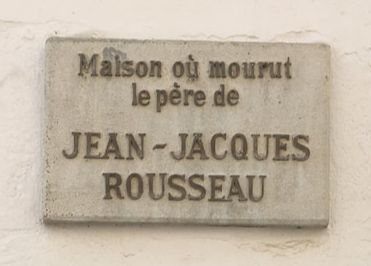
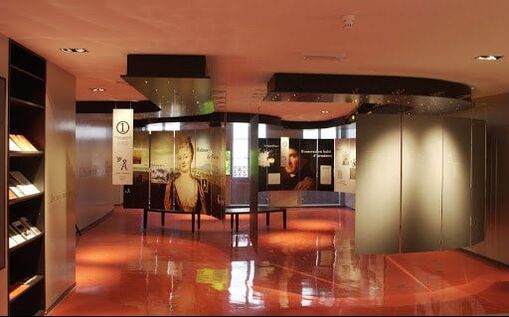
From where we sit, the two most interesting of the philosophes were Rousseau (because he was born in Geneva) and Voltaire (because he ended up here). Rousseau's father lived in Nyon and in his Confessions Rousseau describes coming to visit him. 

'It was necessary to pass through Nyon: could I do this without seeing my good father? Had I resolved on doing so, I must afterwards have died with regret. I left Merceret at the inn, and ventured to his house. How wrong was I to fear him! On seeing me, his soul gave way to the parental tenderness with which it was filled. What tears were mingled with our embraces! ...I continued my journey the next morning, well satisfied that I had seen my father, and had taken courage to do my duty.'
Picture
I wonder if any of you can find the house? It's less than 500m from where our school used to be. ​​
Picture
Rousseau museum Geneva
Picture
Voltaire's house in Ferney
For those desperate to know more see my textbook IB History of Europe Course Companion pages 1-10. An edited extract on the ideas behind the revolution is here.

Alternatively, if jumping ahead a few years and trying a Higher Level IB Diploma text is not enough of a challenge for you, why not try some history from Yale University?

The late great John Merriman (1946-2022) was recorded lecturing a 'history 202' course for Yale undergraduates 'European Civiliization' (left). This episode covers the impact of the Enlightenment, much of which you will easily understand.

​He also does later lessons on the French Revolution and Napoleon, as well conveniently covering the whole of Matu course up to the end of the Second World War. 
Political causes

In any political revolution, political causes are central. In the end, the people must be willing to forcibly remove rulers whom they feel are responsible for the country's ills. The economic and social problems of France created a context in which people wanted change. The ideas of the philosophes provided arguments about what should change and why. But history shows that revolution can be avoided when rulers are skilled, determined and ruthless. Unfortunately for the future of the French monarchy, Louis XVI was none of these things.

Individuals in history can make a difference, even if in simplistic historical explanations there is a temptation to explain too much based on simple character traits. The documentary at the top of this page is typical of this 'bad King John' theory of history. There is little doubt that Louis and his wife Marie Antoinette were not ideal monarchs for a time of crisis. Louis was not interested in ruling and their personal difficulties and extravagance did much to undermine their authority. The fact that at Versailles they lived a life of extraordinary opulence, surrounded by sycophantic courtiers and were literally detached from the French people in a 1000 room palace, 18km from Paris, was not their fault. This was how it had always been.
'Bad King John' theory of history.

This was expounded by historian E.H. Carr in his famous 'What is History?' lectures in the 1960s. This is the tendency for popular history to explain the essence of an age, its successes and failures, as being the result of the actions of individuals, whether good or bad. Carr call's this tendency 'childish'.
Unlike in many other European countries the French state and political system had significantly changed despite the significant social and econmic changes we saw last lesson. Both the First and Second Estates also had their own advisory and legislative bodies that were used by the king, especially when he needed support their support.  The Assembly of Notables (Assemblée des Notables) was a handpicked group of nobles, clergy, and officials called by the king (not elected) to advise on major issues, especially taxation or reforms. Also important were the regional Parlements which were courts (confusingly not parliaments in the English sense) like the Paris Parlement which could not make laws but could stop the king form doing whatever he wanted. Importantly, there was no institution to represent the Third Estate except the Estates General and this had not met since 1614. 
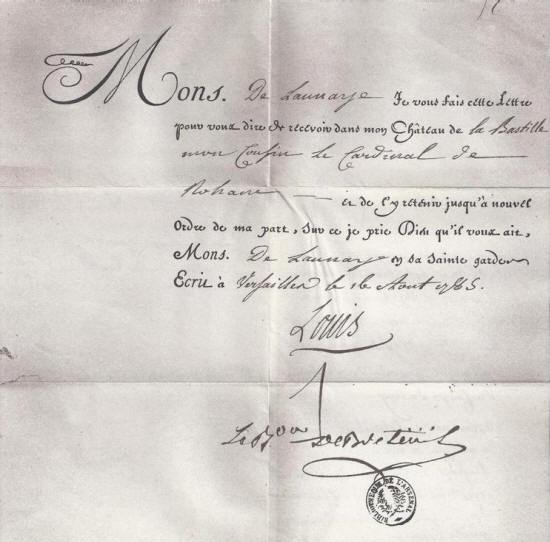
The Estates General had three separate assemblies for each of the Three Estates: the clergy, nobility and the rest.  It had no power in its own right - unlike the English parliament it was not required to approve royal taxation or legislation - instead it functioned as an advisory body to the king. It was appointed and dismissed by him. It was this political system that many French people - including some members of the clergy and nobility - believed needed to change. In reality, France was governed by the thousands of noblemen who lived alongside Louis XVI at Versailles. In the absence of any checks and balances on their power, this rule became increasingly despotic. One of the best examples of this was the widespread use of lettres de cachet or sealed letters. Lettres de cachet were royal warrants ordering the exile or imprisonment of the person named in it. The king could sign these and give them to his ministers to use as they wished, it was up to them to put a name in it. Quite often they were used by ministers to imprison rivals or critics of the government in the Bastille. Voltaire, for example,  received two lettres de cachet. They could be entirely arbitrary, without either justification or right of appeal. During the reign of Louis XVI 14,000 such letters issued.  For many, lettres de cachet were a potent symbol of the injustice of the King's rule.
Picture
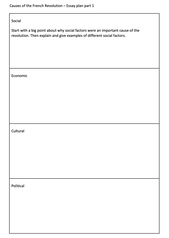
Activity - Causes of the French Revolution - essay plan. (Part 1 - Long-Term Causes)
Picture
Following on from the last essay plan you made on the American Revolution, we are going to apply the same technique to the causes of the French Revolution. If you'd like to, you can download a planning template here.  You can start by incorporating the two paragraphs on social and econmic causes you wrote last lesson. 

On this occasion, I am encouraging you to go beyond the information I have provided to find evidence and examples of your own. I still expect you to respect the PESC structure, but you can go a little further in the development of your points. You might, for example, find other political points/explanations not mentioned in the text above or other examples to illustrate the points/explanations that you make. 

​Remember this is just the first stage in the plan... Short-term causes are to be added later. 
The little sister of internationalschoolhistory.net - Richard Jones-Nerzic- Nyon, Switzerland 2025 
The views expressed on this website are those of the author and not necessarily endorsed by the author's employer. 
  • Home
  • Year 9
    • Unit 1 - Bronze Age Greece >
      • Lesson 1 - Minoa
      • Lesson 2 - Myths
      • Lesson 3 - Atlantis
      • Lesson 4 - The Mycenaeans
      • Lesson 5 - Troy
    • End of Unit Test >
      • End of Unit Test - 1
    • Unit 2 - Classical Greece >
      • Lesson 1 - Archaic Period
      • Lesson 2 - Olympics
      • Lesson 3 - Athens
      • Lesson 4 - Democracy
      • Lesson 5 - Sparta
      • Lesson 6 - Greek Gods
      • Lesson 7 - Greek Legacy
      • End of Unit Test - 2
    • Unit 3 - Roman Republic >
      • Lesson 1 - Foundation
      • Lesson 2 - Republic
      • Lesson 3 - Hannibal
      • Lesson 4 - Julius Caesar
      • Lesson 5 - Rome
    • Unit 4 - Roman Empire >
      • Lesson 1 - Empire
      • Lesson 2 - Roman Nyon
      • Lesson 3 - Pompeii
      • Lesson 4 - Rise and Fall
      • Lesson 5 - Legacy
    • Unit 5 - The early Middle Ages >
      • Lesson 1 - Middle Ages?
      • Lesson 2 - Christianity
      • Lesson 3 - Monasteries
      • Lesson 4 - Justinian
      • Lesson 5 - Islam
      • Lesson 6 - Vikings
  • Year 11
    • Warfare - A study through time >
      • Lesson 1 - Introduction >
        • Warfare - Timeline activity >
          • Students' Timelines 2020
      • Lesson 2 - Medieval >
        • Case Study - 1066 - Battle of Hastings
      • Lesson 3 - Crusades >
        • Case Study - 1271 - Krak des Chevaliers
      • Lesson 4 - New World >
        • Case Study - 1532 - Battle of Cajamarca
      • Lesson 5 - Religion >
        • Case Study - 1572 - St. Bartholomew's Day Massacre
      • Lesson 6 - Napoleon >
        • Case Study - 1796 - Battle of Lodi
      • Lesson 7 - Industrial >
        • Case Study - 1859 - Battle of Solferino
      • Lesson 8 - World War 1 >
        • Case Study - 1915 - The Battle of Ypres
      • Lesson 9 - 1930s >
        • Case Study - 1937 - Nanjing Massacre
      • Lesson 10 - Vietnam >
        • Case Study - 1968 - Tet Offensive
    • Matu 1 - The American Revolution >
      • Lesson 1 - The Scientific Revolution
      • Lesson 2 - The Enlightenment
      • Lesson 3 - Enlightened Monarchs
      • Lesson 4 - Colonising America
      • Lesson 5 - Thirteen Colonies
      • Lesson 6 - Boston Massacre? >
        • Boston Massacre - The Play
      • Lesson 7 - Short-term causes
      • Lesson 8 - Why Britain lost
      • Lesson 9 - Consequences
      • Lesson 10 - How revolutionary?
    • Matu 2 - The French Revolution >
      • Lesson 1 - Introduction
      • Lesson 2 - Causes SE
      • Lesson 3 - Causes CP
      • Lesson 4 - Short term causes
      • Lesson 5 - The Bastille
      • Lesson 6 - 1789-91
      • Lesson 7 - 1793 Execution
      • Lesson 8 - The Terror
    • Matu 3 - Switzerland and Napoleon >
      • Lesson 1 - Ancien Regime
      • Lesson 2 - 1789
      • Lesson 3 - Napoleon's Rise
      • Lesson 4 - Napoleon in Art
      • Lesson 5 - Napoleon's Reforms
      • Lesson 6 - Switzerland 1798-1815
      • Lesson 7 - Napoleon's Europe
      • Lesson 8 - Napoleon: Hero or villain
  • S1 S2
    • Matu 4 - Industrial Revolution >
      • Lesson 1 - Why was Britain First?
      • Lesson 2 - Economics - Agriculture
      • Lesson 3 - Economics - Industry
      • Lesson 4 - Transport
      • Lesson 5 - Social Impact
      • Lesson 6 - Cultural Impact
      • Lesson 7 - Political Impact
      • Lesson 8 - Switzerland
    • Matu 5 - Nationalism >
      • Lesson 1 - Impact of French Revolution
      • Lesson 2 - Napoleon and Vienna
      • Lesson 3 - 1815-48 - Age of Revolution
      • Lesson 4 - Italian Unification - 1830-48
      • Lesson 5 - Switzerland 1815-48
      • Lesson 6 - Italian Unification - 1848-70
      • Lesson 7 - German Unification - 1848-71
      • Lesson 8 - The German Empire
    • Matu 6 - New Imperialism >
      • Lesson 1 - New Imperialism?
      • Lesson 2 - Africa
      • Lesson 3 - Congo
      • Lesson 4 - China
      • Lesson 5 - Japan
      • Lesson 6 - Legacy
      • Jared Diamond thesis
    • Matu 7 - World War 1 >
      • Lesson 1 - Introduction
      • Lesson 2 - Causes
      • Lesson 3 - 1914
      • Lesson 4 - Expectations
      • Lesson 5 - Reality
      • Lesson 6 - Total War
      • Lesson 7 - Switzerland
      • Lesson 8 - Defeat
      • Lesson 9 - Peace 1919
    • Matu 8 - Russian Revolutions >
      • Lesson 1 - Russia before 1917 >
        • Tim Marshall - Russia
      • Lesson 2 - 1905 Revolution
      • Lesson 3 - February Revolution
      • Lesson 4 - Marxism
      • Lesson 5 - Lenin
      • Lesson 6 - The Bolsheviks
      • Lesson 7 - 1917-18
      • Lesson 8 - Civil War
    • Matu 9 - USA 1919-41 >
      • Lesson 1 - 1920s boom
      • Lesson 2 - Roaring 20s?
      • Lesson 3 - Crash
      • Lesson 4 - 1932 Election
      • Lesson 5 - New Deal
      • Lesson 6 - Judging the New Deal
    • Matu 10 - Totalitarian States >
      • Lesson 1 - Modern Authoritarianism >
        • Is Trump's USA authoritarian?
      • Lesson 2 - Fascism
      • Lesson 3 - Mussolini - Rise to Power
      • Lesson 4 - Mussolini - Consolidation of Power
      • Lesson 5 - Mussolini - Aims and policies
      • Lesson 6 - Research presentations >
        • Hitler - Research presentations
        • Stalin- Research presentations
      • Lesson 7 - Hitler - Germany 1933-45 >
        • Hitler - Rise to Power
        • Hitler - Consolidation of Power
        • Hitler - Aims and policies
      • Lesson 8 - Stalin - USSR 1924-41 >
        • Stalin - Rise to Power
        • Stalin - Consolidation of Power
        • Stalin - Aims and policies
    • Exams and Revision
  • S3
    • Matu 11 - World War II >
      • Lesson 1 - WW1
      • Lesson 2 - LoN
      • Lesson 3 - Hitler
      • Lesson 4 - Appeasement
      • Lesson 5 - 1939-40
      • Lesson 6 - Japan
      • Lesson 7 - Russia
      • Lesson 8 - Total War
      • Lesson 9 - Defeat
      • Lesson 10 - Switzerland
    • Matu 12 - The Cold War >
      • Lesson 1 - Causes
      • Lesson 2 - Berlin
      • Lesson 3 - 1950s
      • Lesson 4 - 1960s
      • Lesson 5 - 1970s
      • Lesson 6 - 1980s
    • Matu 13 - Decolonisation and the Third World >
      • Lesson 1 - Factors
      • Lesson 2 - Case studies
      • Lesson 3 - Consequences
    • Matu 14 - Switzerland >
      • Swiss Politics
      • Swiss History
    • Exams and Revision
  • IB History
    • IB History - Paper 1 >
      • IB History - Paper 1 - Content
      • IB History - Paper 1 - Past paper questions >
        • Question 1a
        • Question 1b
        • Question 2
        • Question 3
        • Question 4
      • IB History - Paper 1 - Skills
    • IB History - Paper 2 >
      • IB History - Paper 2 past paper questions
      • IB History - 7. Industrialization >
        • IB History - Past paper questions - Industrialization
        • IB History - First and Second Industrial Revolution
        • IB History - Steven Johnson
        • Activity 1
      • IB History - 8. Independence movements >
        • IB History - Past paper questions - Independence movements
        • IB History - Revision Template - Independence movements >
          • IB History - Independence movements - Theme 1 - Origin and rise
          • IB History - Independence movements - Theme 2 - Methods
      • IB History - 10. Authoritarian States >
        • IB History - Emergence of authoritarian states
        • IB History - Consolidation and maintenance
        • IB History - Aims and policies
        • IB History - Past paper questions - Authoritarian states
        • IB History - Revision Template - Authoritarian states >
          • Hitler - Germany and Castro - Cuba - A comparative analysis (Part 1)
          • Hitler - Germany and Castro - Cuba - A comparative analysis (Part 2)
          • Hitler - Germany and Castro - Cuba - A comparative analysis (Part 3)
      • IB History - 11. Warfare >
        • IB History - Past paper questions - Warfare
      • IB History - 12. Cold War >
        • IB History - Past paper questions - Cold War
        • IB History - Revision essay plans - Cold War >
          • Cold War - 1943-49 - Rivalry, mistrust and accord
          • Cold War - 1947-79 - Rivalry, mistrust and accord
          • Cold War - 1980-91 - Rivalry, mistrust and accord
          • Cold War - Leaders, nations and Cold War crises.
    • IB History - IA - Internal Assessment
  • TOK
    • Critical Thinking >
      • Lesson 1 - Thinking >
        • Lesson 1 - Test
      • Lesson 2 - Language
      • Lesson 3 - Senses
      • Lesson 4 - Reason
      • Lesson 5 - Emotion
      • Assessment >
        • Movie perception test
        • Complete film
        • Student Films 2021
    • Core theme - Knowledge and the knower >
      • Knowledge framework
    • Areas of Knowledge >
      • History >
        • Scope in history
        • Method and perspective in history
        • Ethics in history
      • Human Science >
        • Scope in human science
        • Method and perspectives in human science
        • Ethics in human science
      • Natural Science >
        • Scope in natural science
        • Method and perspectives in natural science
        • Ethics in human science
      • Maths >
        • Scope in maths
        • Method and perspectives in maths
        • Ethics in maths
      • Arts >
        • Scope in the arts
        • Method and perspectives in arts
        • Ethics in the arts
      • Politics >
        • Scope in politics
        • Method and perspectives in politics
        • Ethics in politics
      • Technology >
        • Scope in technology
        • Method and perspectives in politics
        • Ethics in technology
      • Language >
        • Scope in language
        • Method and perspectives in language
        • Ethics in technology
    • Assessment >
      • TOK Exhibition >
        • TOK Exhibition 2023
        • TOK Exhibition 2024
        • TOK Exhibition 2025
      • Essay
  • Film Workshop
  • About